Marc Lane and Regina Haertsch wrote a submission to the Draft Guide to Transport Impact Assessment, lightly edited below. The parts of the Guide that directly address walking are unobjectionable in themselves, requiring consideration of walking space and safe crossing locations. Our concerns are rather with the lack of imagination around continuing to design for high levels of car mode share, and this is what the submission focuses on.
As the peak body advocating for walking in the Greater Sydney region, WalkSydney welcomes the opportunity to provide input into this new guide.
Transport Assessment should start with walking and cycling
In London, a mandatory Healthy Streets Transport Assessment starts by identifying all the destinations within walking and cycling distance required to support a car-free lifestyle, and then identifying what infrastructure supports accessing them. Where infrastructure is missing, the development must contribute to that infrastructure being built:

This approach turns on its head the approach of the Guide to Traffic Generating Development (GTGD) and, to a degree, the Guide to Traffic Impact Assessment (GTIA). Rather than assuming a traffic generation rate (with slightly less, or more cars), It starts with the proposition that new development should be car-free. This has a direct and clear line of sight not only to transport policy but also public health and Net Zero, which is equally important here. Such an explicit objective will complement and be consistent with the NSW Government’s Transport Oriented Development Program. As The Netherlands has demonstrated since the 1960’s, it is essential to design for a desired transport outcome.
This same logic should be taken into Chapter 4 Travel Demand Management – requiring for example Green Travel Plans (ie reduction of car travel) as its primary aim, rather than merely peak-spreading or rerouting of the same volume of traffic elsewhere.
The GTIA must adapt to the Climate Change (Net Zero Future) Act 2023
The Net Zero Commission is due to set sectoral targets including Transport, the second largest emitter after energy. As WalkSydney recently stated to the Federal Climate Change Authority (CCA), mode shift is key to low emissions transport. The countries that are changing their transport emissions the fastest are doing so by embracing mode shift. Compare Australia, where the CCA are predicting GHG emissions to rise from cars, vs France where GHG emissions from transport are stable and falling, particularly cars:

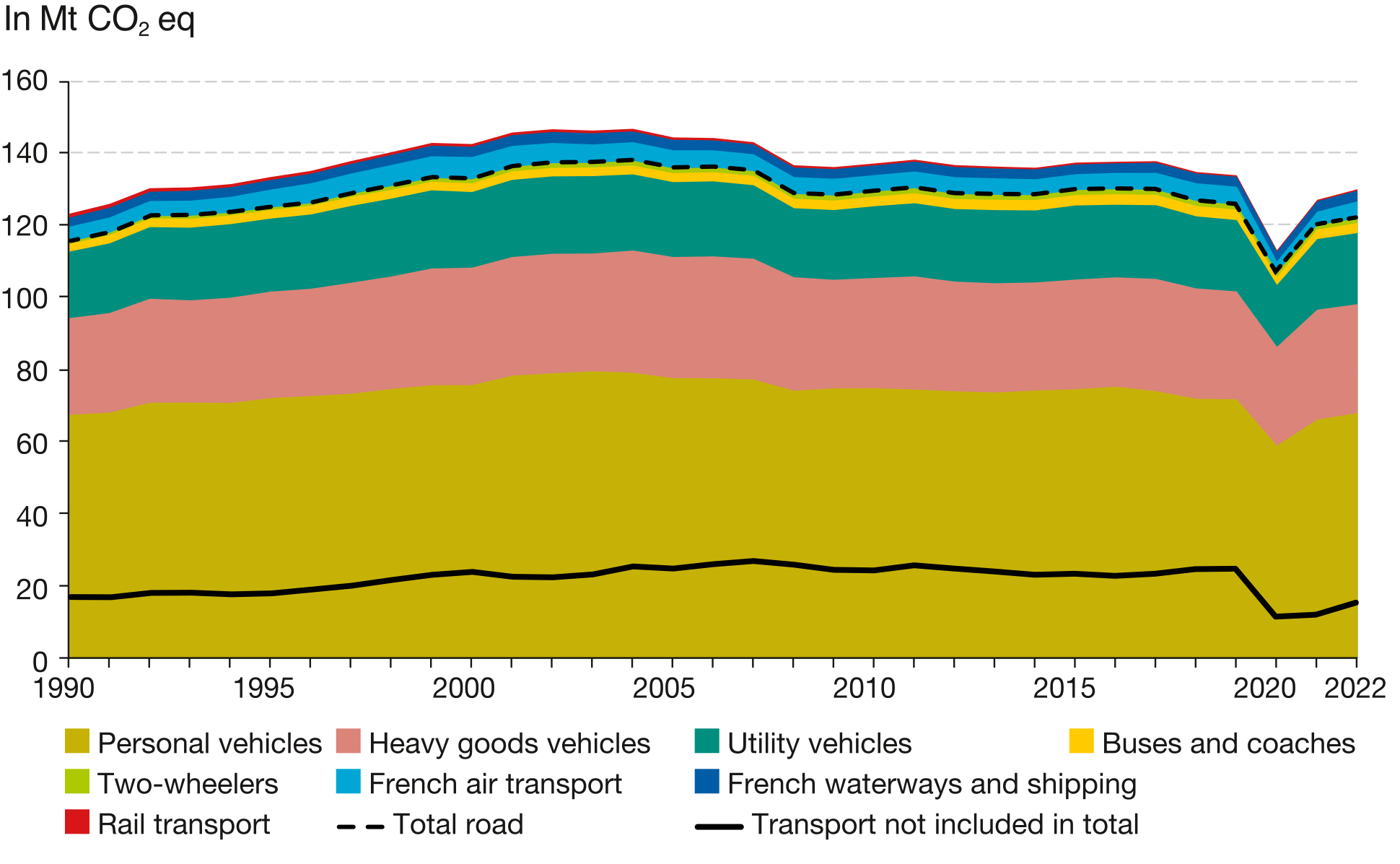
This can be directly correlated to the high and rising non-car modes in major cities in France through policies such as halving parking spaces (and taxing SUVs), to achieve mode shift and flatten transport sector emissions:


Mode shift from car travel to walking and riding can and does occur if the right policies are put in place to make it a realistic choice for people. Major policies like GTIA must do more to make this happen. More walking and riding has a range of co-benefits including:
- improved health (reduced healthcare costs)
- reduced congestion,
- reduced road trauma and road violence, as a consequence of reducing vehicle speeds to support walking and cycling (eg. Beyond Vision Zero in Scandinavia)
Behavioural research indicates that there is a sizable demographic cohort who would walk and bicycle in a less threatening road environment. This was evidenced in the COVID lockdown period when motor traffic volumes were greatly reduced. Not only were more people walking and cycling, there was a wider social cross-section who were active – children, the elderly and people with disabilities. Less parking can drive more walking.
The consequences for the GTIA of a mode-shift agenda
In the context of the above, the Guide to Transport Impact Assessment must not only correct the deeply entrenched bias towards cars within the former Guide to Traffic Generating Development, but it must counter bias in transport planning practice and the development industry of blindly catering for a high car mode share. NSW generally has double the mode share that the Climate Council’s Shifting Gear estimates we need to achieve equitable climate change adaptation (37% car mode share, or less).
A ‘low risk’ option is to base the indicative mode shares in Chapter 5 (eg. page 55) on the mode shares that reflect context, not type. For example, residential development in accessible parts of Sydney (eg: ‘Category 1’ in Table 8.2) should start with the same indicative mode share. These should also be based on the parts of Sydney we want and know can be achieved (not just the average of what we’ve got from surveys, which ‘predicts and provides’ for current motorcentricity).
For example, mode shares for Category 1 could be based on the Inner West LGA. According to Transport for NSW’s 22/23 Household Travel Survey, this LGA already achieves a 33% walk mode share and 13% public transport mode share, (due to destinations within walking or a reasonable bus trip’s distance from homes, good walking paths, reliable transport – ie ‘Category 1’ factors) and very low rates of parking. Tellingly, with increasing density Inner West Council is reducing parking supply further, by turning council carparks into more housing.
Other Category 1 areas can emulate this, and provide less parking. Category 1A could be based on the City of Sydney and North Sydney, and Category 2 based on progressive (but less well served) areas like Wollongong (78% car mode share, 14% walking on average, despite lower transport access), Then, if required, modifiers could be provided for either local access considerations (eg. within 800m of a station or local centre), or else by typology (eg: medium density – car mode share roughly half of average).
A higher ambition approach would be to start with the mode share we need to achieve to reach Net Zero (ie 65% non-car modes on average) and then de-average this to reflect the different contexts of NSW (again, this could be using the Table 8.2 categorisation). So, Categories 1A and 1 may need to achieve a lower mode share to do the ‘heavy lifting’ for reducing VkT overall (since they are dense and have good alternatives, while Category 3 could aspire to better than 91% car mode share, but not yet be radically low (again, like Wollongong LGAs 78% car mode share).
Modelling should also be undertaken of various mode shares and their impact on future transport requirements and their emissions. For example, if achieving a lower mode split in Category 1 areas could avoid another $23bn motorway from being required, then there is strong incentive for the guide to mandate this mode share, and for government to reallocate those billions to slowing speeds down, rolling out the Strategic Cycleways, or increasing the public transport frequency, to support lower carbon movement. Currently, the transport budget is spending as much on 4 Eastern Harbour City motorways as it is on all buses, trams, trains, bikes and walkers – so there is plenty of ‘room to move’.
Training and Support of Councils is Required to Catalyse Change
The AITPM presentation on the GTIA and the councillor from Campbelltown’s comments in particular demonstrates the need for support and training for councils to be provided if the Guide is adopted widely. To the extent that the council’s DCPs, and not the Guide, prevail, councils will need to be convinced and assisted to apply the parking categories. The SA2 level categories are likely too broad for most councils, and assistance in devising smaller and more locally relevant rates will require data, technical knowledge and time.
Transport for NSW should therefore:
- Make available to councils the methods for both estimating mode share and parking rates for their council area;
- Fund and provide personnel to work with councils to update their rates within a set period of, say, 12 or 24 months
- Require councils to review their parking rates by the end of that period (in much the same way that GSC required councils to public LSPS’ by a fixed date).
We look forward to seeing a final guide with maximum parking rates (which could be negligible or zero in certain areas), strong guidance in the TIA and TDM sections to support mode shift to active transport, and a program of training and assistance for councils to implement the new guide.
You must be logged in to post a comment.