This submission prepared by David Martin and Marc Lane.
WalkSydney welcomes the opportunity to provide input to CCA’s advice to government on pathways to support Australia’s transition to net zero. We welcome the framing of the paper highlighting the need for urgent, science-based action to even stay within hope of achieving a +1.5 degree temperature rise.
CCA’s issues paper “The Paper” emphasises the achievability of pathways and targets as a key consideration. However, Australia is no stranger to reform in economic, cultural and social domains. The importance and urgency of climate change action should be clear. Political vision and leadership will be required for embarking on economic, cultural and behavioural change to achieve Net Zero. Governments at all levels will need to demonstrate that they are committed to bringing about the change required. Political and institutional timidity is not an option.
Reducing transport emissions will make a significant contribution to this transition, both directly in reducing ICE vehicle kms, as well as integrated land use and transport planning. Figure 5 of your report shows Energy and Transport alone are almost 50% of all Scope 1 emissions.
The Paper overstates the benefits of vehicle electrification and understates or misstates the benefits and opportunity of supporting more walking and riding
Disappointingly the Advice discusses transport only in relation to decarbonisation by electric cars or vehicles using new fuels. Car-based transport is 87% of sectoral emissions (in your calculation), and you make the point that BEV is mature, yet take-up in Australia is slow. CSIRO projections show a likely undershoot against targets without more concerted action. Therefore, relying on fuels alone is unlikely to achieve decarbonisation – so a ‘technology driven’ solution is inadequate.
Mode shift is key to low emissions transport
Your discussion of mode shift as a solution starts in the negative, “Mode shifting to active and public transport can be impeded by consumer preferences, safety concerns, weather conditions and fitness of travellers, but can be enabled by well planned cities and service improvements. Co-benefits include improved health, reduced congestion and increased road safety” (at 25).
This not only undersells the capacity for mode shift to decarbonise transport, but repeats half-truths that are contrary to evidence that it is consumer preference, weather and safety concerns, rather than lack of infrastructure and service patterns, and conversely the massive investment we make in roads that makes car driving preferable, that makes active and public transport unattractive. Failure to recognise these facts will hinder setting policies and trajectories to achieve Net Zero transport.
The countries that are changing their transport emissions the fastest are embracing mode shift. Compare Australia, where you are predicting GHG emissions to rise from cars, vs France where GHG emissions from transport are stable and falling, particularly cars:

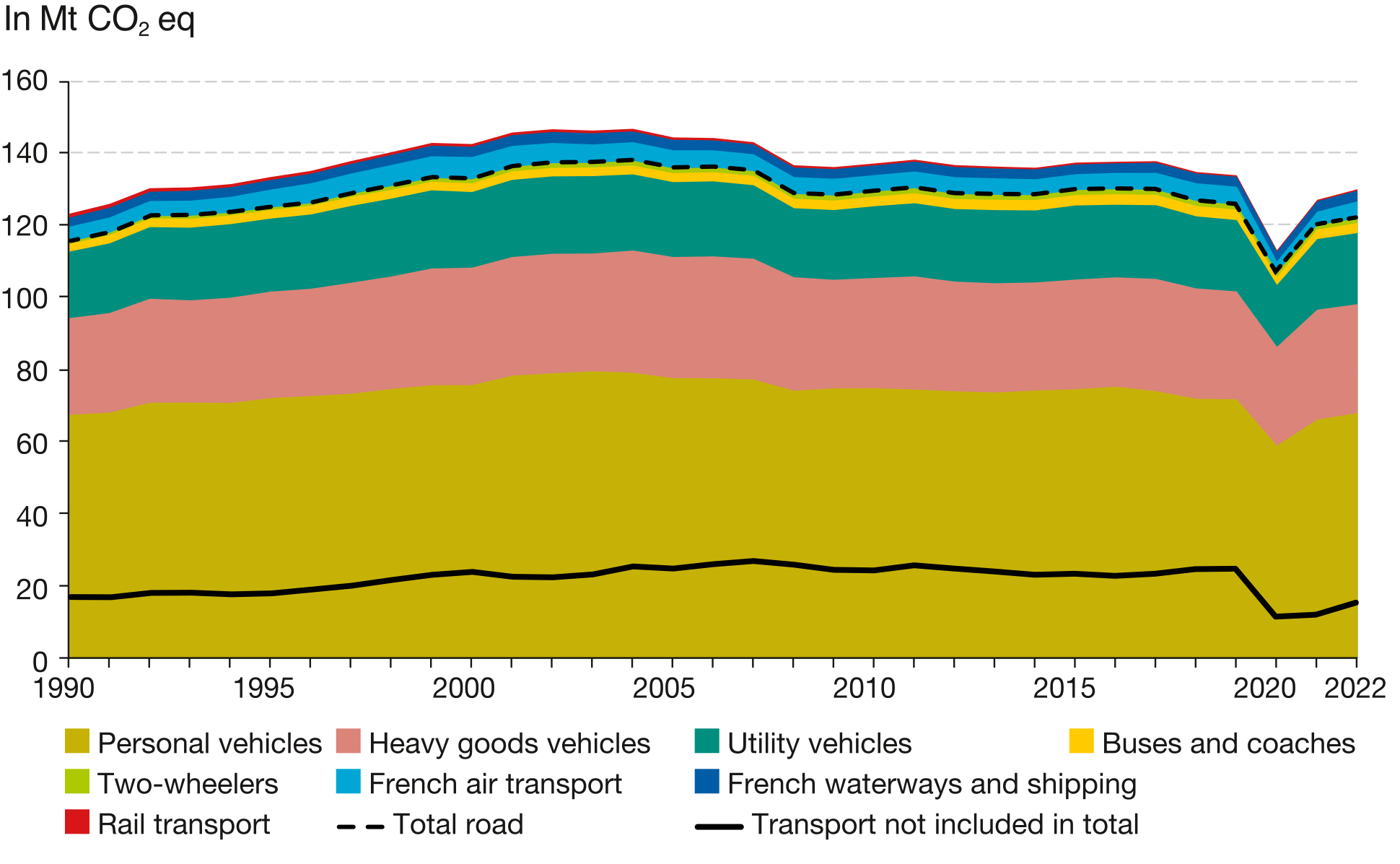
This can be directly correlated to the high and rising non-car modes in major cities, such as:


Every solution should be on the table: this is a climate emergency
The emphasis of the paper on ‘technologies’ over ‘policies’ is also unhelpful to achieving decarbonisation.
Better integrated land use and transport (LUTI) planning can reduce the need to travel by any mode, and can favours short trips on foot and by bike. Achieving this requires policy change, not technology. Attached housing has higher thermal mass than detached houses, as well as creating more walkable dense suburbs, but this requires planning systems change. A better mass transport systems can minimise the need for private vehicle long-distance travel and maximise travel by low carbon. Solutions include removing minimum parking policies, increasing public transport – bus and train services and infrastructure and providing safe and comfortable infrastructure for walking and riding. These all require policy, investment and decision-making framework changes.
Supporting more walking and riding will cost less than electrification & provides a wider range of benefits
Mode shift from car travel to walking and riding can and does occur if the right policies are put in place to make it a realistic choice for people. Supporting more walking and riding has the potential to have more impact at less cost than technology change, because of the range of co-benefits including:
- improved health (reduced healthcare costs),
- reduced congestion,
- reduced road trauma and road violence by reducing vehicle speeds like the majority of other developed nations (particularly if Australia adopts safe speeds on all local roads that make it safer and more attractive for everyone to ride – encouraging societal mode shift).
This is all known – as your paper highlights, walking and cycling are already ‘ready to roll out’. The reach of walking and riding modes is already being extended through a variety of micro-mobility electric vehicles such as e-bikes and e-scooters – where (or if) they are permitted to operate.
Invest more in walking and riding infrastructure
The Government must increase investment in infrastructure to support walking and riding. The factors preventing mode shift are not technological, but they are deep and engrained in existing transport planning and decision-making culture. Our transport investment is heavily geared towards big projects and technologies. For example, the Federal Government has committed to $2.6bn in Roads to Recovery, and $3.25bn on Local Roads and Community Infrastructure, yet only $100m on active transport (1.7%) – the largest AT investment yet.
Walking and riding are widely acknowledged in Europe, Japan and Korea as being essential elements in helping to lower emissions, and to create efficient and liveable cities. Detailed evidence for the role walking and riding can play is outlined in the Climate Council’s ‘Shifting Gear: The Path to Cleaner Transport’. Building on this report through more analysis about walking and cycling, would demonstrate a greater mode share in many inner urban areas than the report predicts increasing the benefits currently being achieved.
WalkSydney says that achieving more walkable and rideable urban areas is readily achievable in the short to medium term by shifting infrastructure investment and a default speed limit of 30 km/hr.
Develop a pathway to fast-track safe speeds for Australian Communities
The introduction of 30 km/hr speed limits has progressively occurred in overseas and local jurisdictions. Uptake in Australia has been slow by state and territory governments. The pace of changes has prevented mode shift, causes too many preventable deaths and touches too many families. Road violence is the biggest killer of children in Australia today. Speed reduction can be achieved at the stroke of the regulatory pen, with minimal traffic management interventions. Public education campaigns can help to explain the rationale and the benefits, to reinforce and generate broad community support.
The Commonwealth’s National Road Safety Strategy is too weak on the need to reduce speeds. Reducing speeds on all roads is the fastest and cheapest way to address road trauma. Reducing speed is also essential for encouraging mode shift.
Lower speed limits are also beneficial for other forms of harmful emissions, like PM2.5. An evaluation of 20mph zones in London by Imperial College, showed in 20mph (30km/h) zones vehicles moved more smoothly, with fewer accelerations and decelerations, than in 30mph (50km/h) zones. This smoother driving reduces particulate emissions from tyre and brake wear – a significant cause of air pollution from both EV and ICE vehicles. Further evidence of the impact of vehicle speed on emissions and health is set out in Transport for London’s (2018) Speed Emissions & Health evidence summary available at: http://content.tfl.gov.uk/speed-emissions-and-health.pdf
More importantly, however, lowering traffic speeds reduces the dominance of motor vehicles and makes our streets safer, more inviting, less polluted and more attractive for walking, cycling and public transport trips. This is essential for ensuring we increase active and sustainable travel, the lowest carbon modes.
A change to transport investment is required
Transport investment has long been based on outmoded economic decision-making methodology. Benefit Cost Analysis values travel time savings and aggregates them to demonstrate expected benefits for infrastructure investment. BCA fails to integrate the value of human (social and behavioural) and environmental benefits. Traffic modelling for infrastructure projects has been shown to derive results not borne out in reality. There is also a continued preference for large-scale capital works for non-strategic reasons (such as ‘announceability’, ribbon cutting, ease of asset sale)
Investment in active transport projects and livable streets and public places therefore remains pitiful. Where the UNEP recommends 20% active transport spend (as a proportion of the transport budget) only 0.13% of NSW’s annual state transport budgets to walking and cycling. In fact NSW is spending as much CAPEX on four motorways as on all other transport (other than Metro) – more than on all its buses, trains, trams, bikers and walkers. Where the Federal government has granted funding specifically for active transport (such as in the road safety portfolio), the money is spent non-strategically, through a call to councils to fund crossings and pram ramps. Meanwhile strategic cycleways are not being delivered, and pedestrian safety has flatlined. This issue is not unique to NSW.
Learning from COVID-19
Behavioural research indicates that there is a sizable demographic cohort who would walk and bicycle in a less threatening road environment. This was evidenced in the COVID lockdown period when motor traffic volumes were greatly reduced. Not only were more people walking and cycling, there was a wider social cross-section who were active – children, the elderly and people with disabilities. COVID lockdown demonstrated the readiness of people to walk and cycle, in the relative absence of threatening motor vehicles.
The COVID period also saw fast-tracked implementation of ‘pop-up’ cycleways, lane and street closures, demonstrating the ability of government at state and local levels in Sydney to deliver walking and cycling infrastructure due to ready availability of network and project plans, and cooperation and collaboration across agencies and jurisdictions.
Recommended pathways for the final paper
Invest 20% of the transport budget on walking and riding
A target of 20 percent of transport budgets should be spent on active transport infrastructure alone (that is, not as part of a larger road package with ‘some active transport elements’).
Develop mode share targets to correct institutional bias for private motor transport
Mode share targets should be reframed at national, state and territory levels from the majority of trips occurring with private vehicles to most happening on public transport or by walking, bike riding, and similar active modes. A mode share hierarchy is essential. The hierarchy is well established overseas (and in NSW) – walking first, then bikes, then public transport, then deliveries/servicing, PUDO, freight, and private vehicles last.
We need to achieve less than 36% car mode share (‘Shifting Gear’ (op cit) ). Measures to disincentivise car use are therefore needed. ‘Road diets’, that is, limiting road space available for motor vehicles and reallocating existing road space to walking and cycling is needed.
Tie funding grants to better land use policies
One of the primary determinants of walking is having daily destinations within walking distance, followed by infrastructure to walk on. Low cost broad scale solutions like requiring state government planning authorities to permit low impact mixed use within 400m of all homes, require footpaths in all new development and crossings on busy roads every 200m or less would substantially improve planning for walking. A raft of other policies, like banning minimum parking standards (as in New Zealand), or replacing the flexible ‘urban growth boundaries’ with a hard ‘green belt’ would also assist – particularly in Sydney where tracts of prime agricultural land near the city is in the process of being rezoned for housing, at the cost of both food security and short trips for perishable fresh food. Funding cycling and public transport over new road infrastructure could also be baked into policy. You need a refreshed Federal Urban Design Protocol, with tied grants to implementing its principles.
Change business case processes for Federal funding, and only fund roads as a last resort
A Federal investment policy must require all business cases to exhaustively explore public and active transport alternatives to new road-building projects first, and have a positive provision policy for walking and cycling, in order to qualify for Federal funds. Travel time savings for private cars should be excluded from business cases, as is already done in the UK. This is essential to avoid inducing demand for more vehicle kilometres travelled and cars on the road with population growth, which you project to frustrate emissions reduction to 2030.
WalkSydney recommend the “National partnership agreement between the state, territories and the Commonwealth to reduce emission from transport” must :
- Invest more money in walking and riding: A target of 20% of transport budgets should be spent on active transport infrastructure.
- Develop mode share targets and tie transport investment to achieving mode shift to address institutional and cultural bias towards investment private vehicle transport.
- Tie Federal funding to:
- better land use and transport integration policies
- a simple and easy active transport investment program like “Roads to Recovery” to distribute investments fast without too much red tape
- Better business case rules to reduce other kinds of road investment
- And of course, Revise the National Road Safety Strategy to fastrack safe default speeds (30km/hr) for all Australian communities.
You must be logged in to post a comment.